Bibtex
 @inproceedings{Zhang2025AlphaWAN,
 title={Towards Next-Generation Global IoT: Empowering Massive Connectivity with Harmonious Multi-Network Coexistence},
 author={Ziyue Zhang, Xianjin Xia, Ruonan Li, and Yuanqing Zheng},
 booktitle={Proceedings of the ACM SIGCOMM 2025 Conference},
 year={2025},
 doi = {https://doi.org/10.1145/3718958.3750504}
 }
Abstract
LoRaWAN offers a compelling solution for delivering cost-effective network access to millions of IoT devices worldwide. However, operators face challenges in scaling their services to meet the growing demands of IoT connections. Moreover, current LoRaWANs foster competition rather than cooperation among coexisting networks, resulting in substantial capacity degradation as network density increases. To identify the root causes limiting LoRaWAN scalability and to enable harmonious coexistence among network operators, this paper conducts an in-depth investigation of operational LoRaWANs. For the first time, our study reveals that the capacity degradation in LoRaWAN is not due to the traditionally believed issues (such as interference or packet collisions in the wireless medium) but rather a newly identified issue termed \textit{decoder contention problem}. This problem cannot be effectively resolved using conventional approaches and will significantly hinder the scaled deployment of LoRaWANs as a next-generation global infrastructure. Based on our new findings, we propose design principles that guide our exploration for effective strategies to address this emerging practical problem. We develop concrete deployable solutions to mitigate contention, optimize spectrum utilization, and promote spectrum sharing among network operators. Extensive evaluations demonstrate that our strategies effectively boost network capacity close to the theoretical bound, and support the coexistence of up to six networks with significant improvement in spectrum efficiency.
Capacity limitations in operational LoRaWANs
Our empirical studies on real-world operational LoRaWANs reveal substantial capacity degradation in two aspects:
(1) Limited network capacity with significant performance gaps.
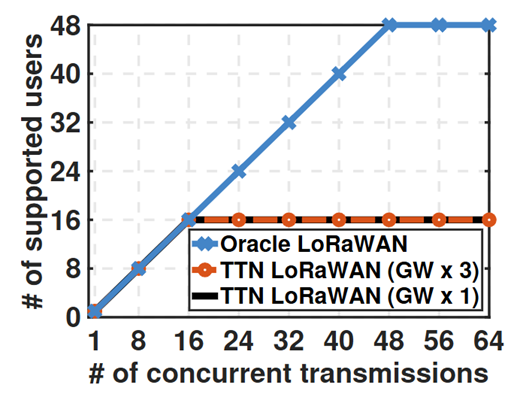
The achievable capacity of operational LoRaWANs is much lower than the theoretical maximum (e.g., less than 35%).
Moreover, our investigations reveal that extra LoRaWAN gateways may not necessarily yield capacity improvements in practice.
(2) Capacity contention across networks.
Since all LoRaWAN deployments operate in the same unlicensed spectrum, they must compete for shared communication resources.
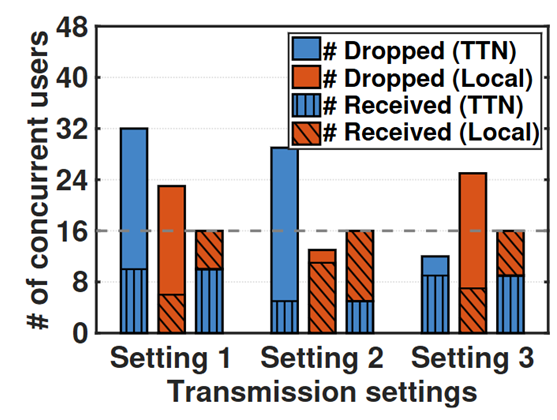
Our experiments with operational LoRaWANs reveal that the capacity limit (\ie, 16 concurrent users) not only constrains individual network concurrency but also caps the total concurrency across all coexisting networks.
Consequently, each network acquires only a fraction of the limited capacity, which diminishes further as more networks coexist.
Causes of capacity degradation
Existing studies primarily attribute such capacity limitations to packet collisions and interference in the shared wireless medium.
However, our study indicates that even in the absence of packet collisions, LoRaWANs still experience significant capacity gaps.
Our in-depth investigation identifies four primary factors that contribute to the practical capacity gaps:
1) Limited capability per gateway:
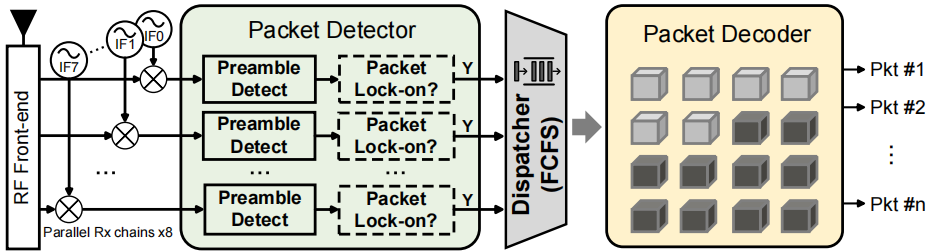
A single gateway monitors multiple channels but can only receive a small portion of packets limited by decoder resources (e.g., 16 decoders per gateway).
As incoming packets are processed in a First-Come-First-Served (FCFS) way, later-arriving packets are discarded when decoders are fully occupied.
2) Inefficiency with homogeneous reception:
Operators typically configure their gateways with standard LoRaWAN channels.
As a result, these gateways operating within the same spectrum observe identical packets in the same order, leading all gateways to receive the early packets while none captures the later ones.

3) Non-optimal operational strategy:
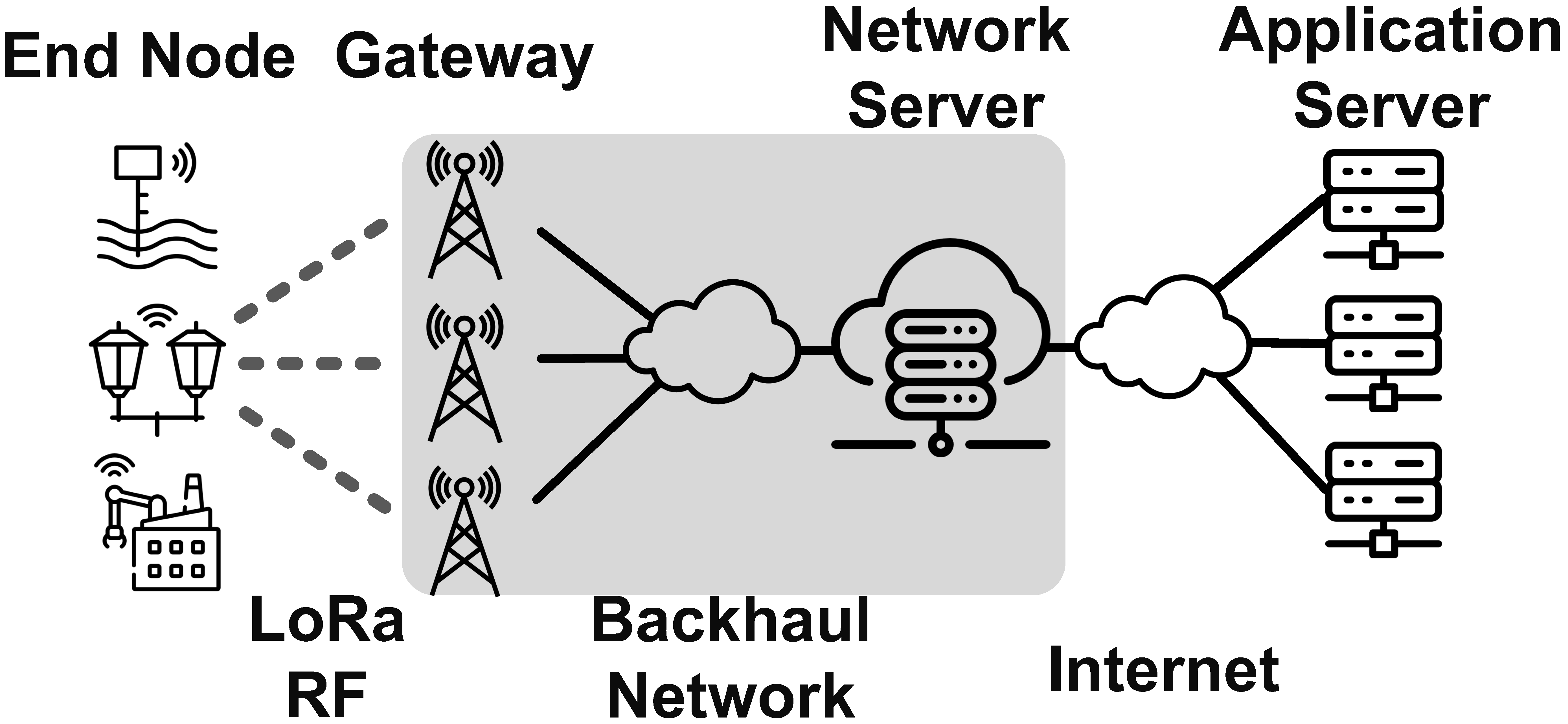
LoRaWAN does not associate users with dedicated gateways.
Instead, all gateways within range receive and forward a user's packets.
While this strategy enhances coverage and redundancy, it can also introduce inefficiencies — some users may unnecessarily occupy decoder resources across multiple gateways, while others may be left without any decoders.
4) Inefficient spectrum sharing:
Current LoRaWANs lack mechanisms for spectrum sharing among network operators.
In multi-network coexistence scenarios, a gateway operating in the shared spectrum detects packets not only from its own network but also from other coexisting networks.
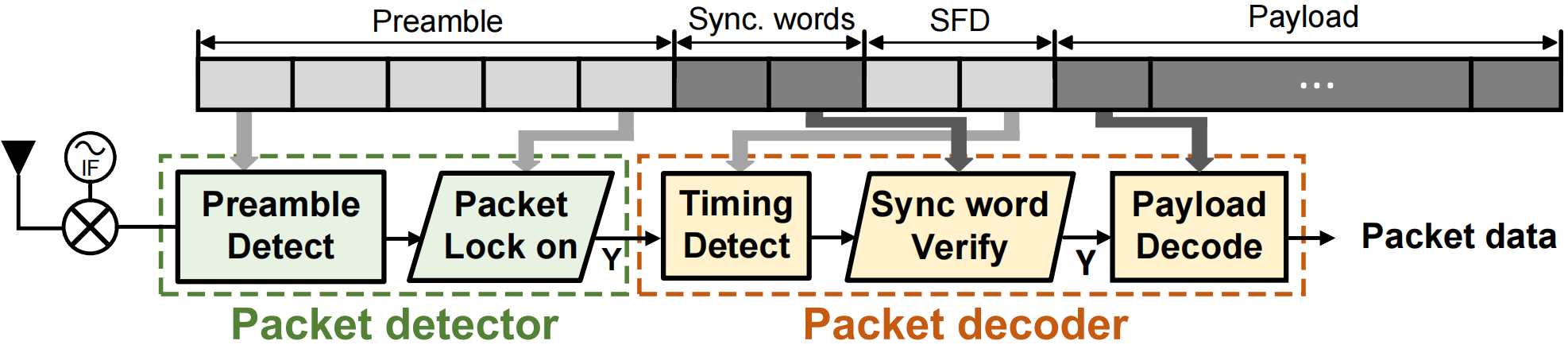
Although LoRaWAN packets include network identifiers, these identifiers cannot be accessed until the packets are successfully decoded.
As a result, packets from all coexisting networks compete for and consume decoder resources at each gateway prior to packet reception or rejection decisions.
Decoder Contention Problem
In summary, the capacity gaps observed in operational LoRaWANs are fundamentally caused by the Decoder Contention Problem as follows:
The practical capacity of a LoRaWAN is limited by the decoder resources of gateways. Suboptimal LoRaWAN operating strategies, such as homogeneous channel configurations across gateways and coexisting networks, lead to intensive contentions for gateway decoder resources among both intra- and inter-network users.
These contentions are further intensified by LoRaWAN's unique characteristics, including operation in unlicensed ISM bands, long communication range, and the absence of user-gateway association.
Specifically, because LoRaWAN allows any gateway within range to receive and forward packets from any user, some users unnecessarily consume decoder resources at multiple gateways, while others fail to access any available decoders.
These factors collectively contribute to the practical capacity gaps of LoRaWANs.
Overview of our solutions
We propose four basic design principles and eight strategies to address the decoder contention problem. In-depth investigations are conducted to explore the suitability of proposed strategies for mitigating decoder contention in real-world LoRaWANs. Please see our paper for details.
We select four strategies for implementation in our \projectname system based on three criteria: (1) no modification to COTS hardware or the underlying protocol; (2) compatibility with legacy systems; and (3) compliance with LoRaWAN and ISM band regulations. We evaluate each strategy based on its practical applicability using commodity LoRaWAN gateways and its effectiveness in real deployments.
| Principles | Strategies | Implementation Method | Practicability | Adopted in AlphaWAN? |
|---|---|---|---|---|
| Optimize spectrum utilization | ① Improve per-channel resource utilization | Adjust the number of channels per GW | Programmable, supported by COTS GWs | Yes |
| ② Heterogeneous channel configuration | Diversify channel configurations of GWs | Supported by COTS GWs | Yes | |
| Add extra resources | ③ More decoders per GW | Upgrade to the newest GWs | Not supported by legacy GWs | No |
| ④ More spectrum resources | Expand to new frequency bands | Limited ISM bands for LoRaWAN | No | |
| Manage user contention | ⑤ Smaller cell with shortened transmit range | ADR, transmit power control | Suboptimal spectrum utilization | No |
| ⑥ Divide large cells into sub-regions | Directional antennas | Less effective to LoRaWAN | No | |
| ⑦ Contention management for LoRaWAN | Joint channel planning and ADR/TPC optimization | Supported by COTS GWs and end-nodes | Yes | |
| Isolate coexisting networks | ⑧ Spectrum sharing across operators with misaligned channel plans | Create channel plans per operator with optimal frequency misalignment | Supported by COTS GWs and the LoRaWAN standard | Yes |
Strategy: Heterogeneous channel planning
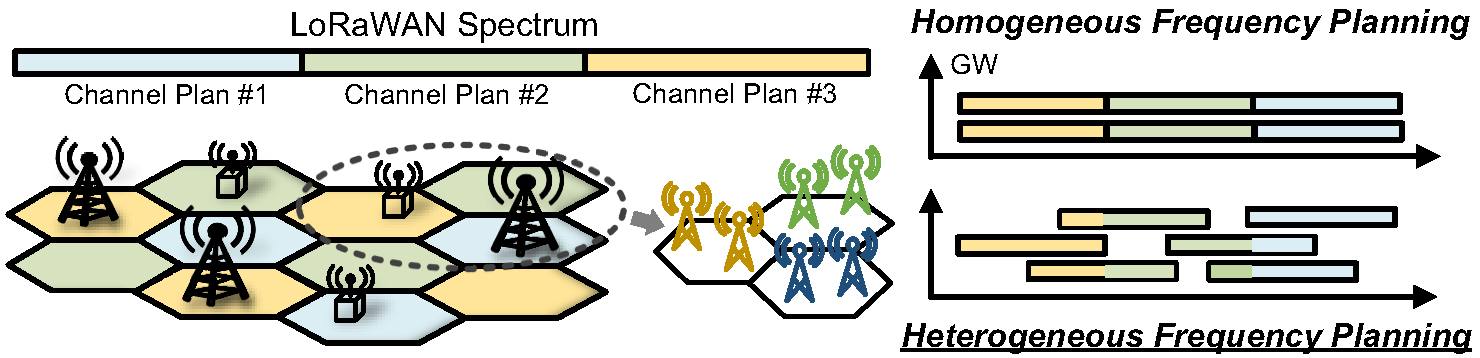
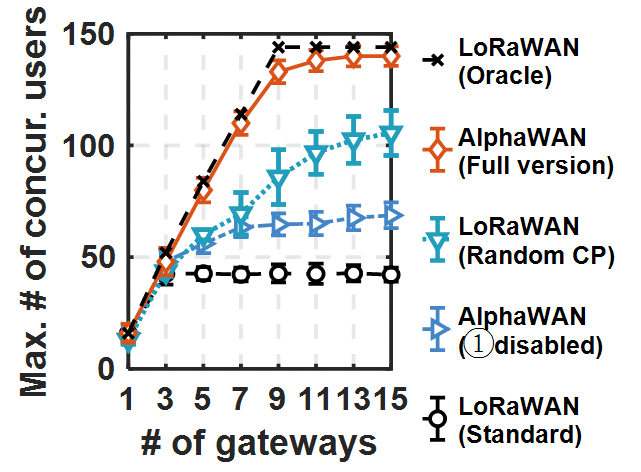
Heterogeneous channel configuration enables co-located gateways to detect distinct sets of packets across different frequencies, with each gateway observing a unique subset of users contending for its decoder resources. This increases the likelihood that a packet arriving late at one gateway may be received earlier at another, thereby improving the chances of successful reception. Consequently, packets from delayed users, which would otherwise be dropped by all gateways in current LoRaWANs, gain a new opportunity for delivery. Importantly, this strategy allows the decoder resources of multiple gateways to be utilized collectively, enhancing the system’s ability to receive additional packets.
Strategy: Spectrum sharing with misaligned channel plans
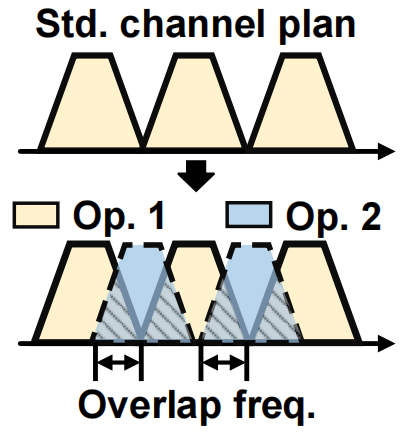
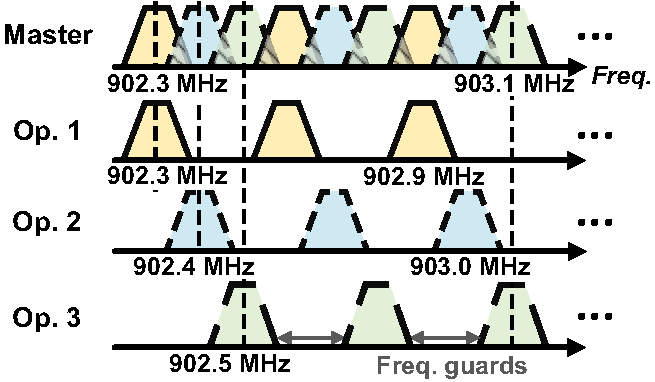
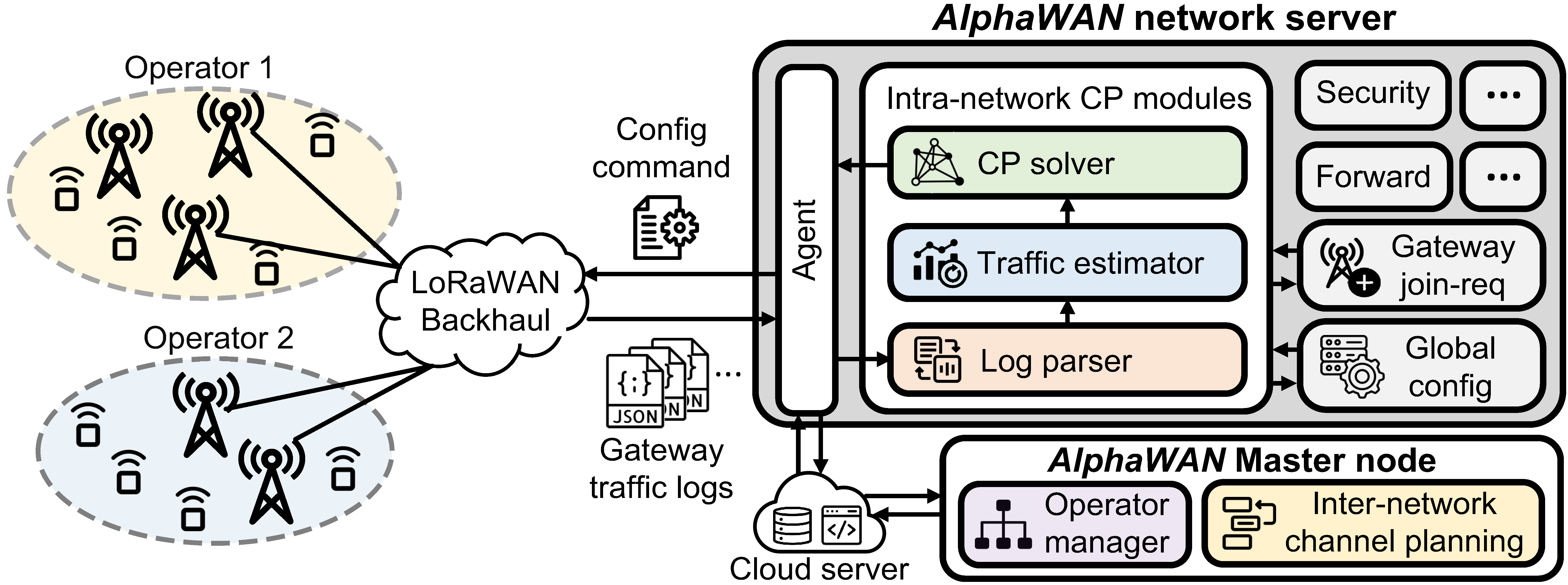
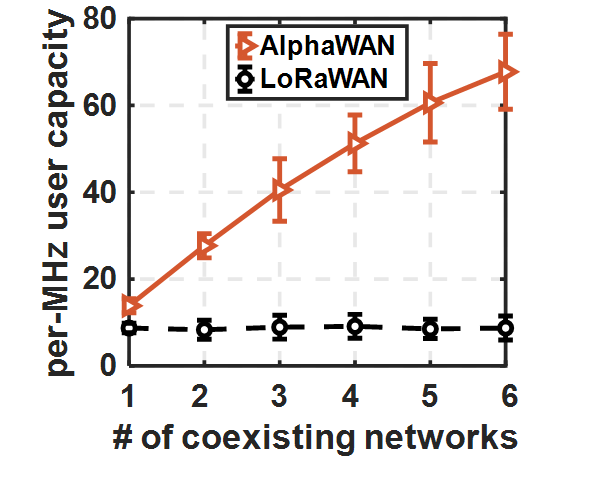
Strategy ⑧ isolates the users of coexisting networks by operating co-located LoRaWANs with distinctive frequency plans. The channels of coexisting networks should maintain proper frequency misalignment. This frequency misalignment could allow COTS LoRaWAN devices to exploit the inherent frequency selectivity of radio hardware to isolate packets from other co-located networks. AlphaWAN facilitates spectrum sharing by implementing Strategy ⑧. It shifts the responsibilities of channel division and maintenance from individual operators to a centralized Master node. The Master estimates the maximum number of networks coexisting in a region and selects a frequency misalignment to divide the LoRaWAN spectrum into frequency-overlapping sub-channels.
AlphaWAN implementation
AlphaWAN operates over the backhaul of a LoRaWAN network, with core components running on the LoRaWAN network server and various application-layer agents running on gateways. AlphaWAN can be readily implemented with COTS gateways and does not require any hardware modifications to deployed LoRa nodes, which allows smooth upgrade of today's LoRaWAN infrastructure.
Real-world performance
Our large-scale testbed deployment shows that AlphaWAN achieves a 3× capacity improvement and approaches the theoretical limit of network capacity. It also enables six LoRaWAN networks to coexist while maintaining high per-network throughput and over 85% PRR.
Acknowledgements:
We sincerely thank our shepherd and the anonymous reviewers for their constructive comments and invaluable suggestions that helped improve this paper. This work is supported by Hong Kong GRF under Grant No. 15218022, 15231424, 15211924, and 15216325.